-
Web 3.0 – 對烏托邦的真理追尋
在這一個萬物皆可 NFT 的時代,我們常說只有賣得出去的叫 NFT,賣不出去的叫 JPG ~~ 取決於你究竟是藝術家、創作者,還是平民 (貧民)😎
一般對 Web 3.0 的冀望在於 Decentralize – DApps、DeFi、DeSoc、DID、DAO、AMA 等都包含其中。而目前的 NFT 是一種個人創作者可自行創作並在各大平台公開販售的數位藏品 (或投資),以盡量減少中間仲介商 (或稱經紀人、掮客)和機構的層層剝削,將由自己創造的利潤大量歸還給創作者本身。像是主流的 Web 3.0 – NFT 市集 OpenSea 收取 2.5% 交易費用,而對應的 Web 2.0 平台 Apple store 收 30% 和 Youtube 收 45% 一對比,落差極大 (儘管還有部分收費)。但是呢 – 去中心化是 Web 3.0 經濟的關鍵原則,而目前仍偏中心化的區塊鏈基礎設施可能會破壞它,因其分散式帳戶節點仍建立在 AWS、Azure、GCP 等中心化巨頭雲端服務之上,真像「1984」、「憤怒的葡萄」等反烏托邦小說一樣,真理都是有距離的。
‘You own all your data’ – 你的個人數據和隱私在那呢?其實在 Meta & Google 手上!如何避免呢?目前的一種做法在於將所有在網路上的行為透過加密演算法加密後存儲到 IPFS 上,對帳戶授權、錢包、資產、數位碳足跡等一併自行管理應用 (不可轉讓的靈魂綁定帳戶~~好抽象)。但窘境是,基礎建設仍不足以應對現在的網路環境,像是現有密碼學強度不足、各協議接口標準不一、節點不夠分散、既有權勢利益干涉、資安觀念薄弱等。Web 3.0 是一個自由的世界,誰都有權利參與;但中心化、去中心化之爭會一直存在,這是一個文化和制度的鬥爭,並不局限於技術領域,是人類社會發展的鬥爭。
目前我也部分轉向 Discord、Reddit、Telegram 使用,近期 Twitter 有些爭議 (Elon Musk – 是在哈囉!)。哈哈,Web 3.0 能不香嗎?待我再看看🤪🐼
-
加密龐克投資警語 – 回顧歷史痕跡
早期理財時的一句話:「你不理財,財不理你;你一理財,財就離開你。」 ~~ 擦鞋童理論、市場大媽理論、反指標
幣圈13~16年時:「幣圈一日,人間十年。」 ~~ 當時就像遊戲代幣、P2P 數位籌碼
幣圈17年後:「幣圈一日,人間一年。」 ~~ 波動變小、詐騙仍在
熊市時期:「別 FOMO,要 JOMO,勤 DYOR。」 ~~ 做好基本面分析、技術面分析、總經、個經、政治情勢、即時新聞資訊
牛市來了:「LFG = All in,to the moon 🚀。」 ~~ 研究+工具+技術+經驗
龐式騙局:「別讓 FUD 影響你,好讓我 Rug pull,怎麼滿地都是 Salt。」 ~~ 歷史最好的教訓就是「大家都不讀歷史,歷史總是不斷在重複。」
-
加密產業相關新創需注意的11個「法律陷阱」
為什麼法律如此重要
加密新創公司開始專注於技術、營銷和社群,但往往忽視法律。構建很酷的東西並把合法視為次要方面是很自然的 (「…但我是去中心化的!」)。
法律影響產品、營運、行銷、合作夥伴關係和公司結構。鑑於快速發展的法律和法規,加密法沒有樣板,不同的律師可能會根據他們的保守程度和對當前趨勢的解釋告訴你不同的事情。
此外,你個人的風險偏好將顯著影響你的判斷,因此你必須了解自己的界限在哪、知識瓶頸。
公司從可靠、經驗豐富的外部顧問獲得有針對性的法律建議至關重要 – 這裡有 11 個重要提示。
1. 正確建構你的公司
在你獲得風險投資資金之前,你需要在你選擇的司法管轄區完成公司註冊的可投資實體,公司組織文件到位,並且與員工、外包商和附屬公司簽訂知識產權協議。
2. 制定內部政策
你需要與你的共同創辦人、員工、外包商和關鍵生態系統成員就可接受的行為設定期望,一隻壞蟲會玷污整個項目的聲譽。
3. 了解你的所有文檔和通訊可能會被發現 – 真正具有隱私性的情況很少
避免在內部溝通中開玩笑、避免說斷章取義的話。在監管傳票或私人集體訴訟過程中發現,你可能需要交出你已發送的所有消息以及有關某個事項的所有文檔。
4. 內容準確
確保你的網站、社交媒體和其他面向外部的訊息準確無誤且沒有誤導性。
5. 有一個條款、條件頁面和隱私政策頁面
盡可能詳細各條款頁面,包括有關你的技術披露、責任限制、保證的免責聲明、風險披露和假設、營銷條款的描述、用戶使用你的前端或參與某些福利的資格標準、禁止行為和地域限制。
6. 了解你的知識產權策略
大多數加密協議是根據認可的開源協議獲得許可的。業界普遍支持這些許可證,因為它們有利於快速應用、迭代創新,但你必須確定自己擁有和執行 IP 的適當實體。
7. 了解代幣發行的稅收影響
如果你的項目涉及代幣,請確保你的公司在代幣發行或出售時結構合理 – 代幣經濟模型需考量分配正義和當地稅收政策 (及未來政策趨勢)。
8. 不要盲從於加密營銷的陷阱
讓 KOL 大肆宣傳你的產品很誘人,但做出沒有事實根據的古怪承諾是個壞主意 – 如果這些承諾沒有兌現,你可能會因欺詐而受到調查。
9. 確保獲得有經驗的外部法律顧問
聘請具有加密產業經驗的顧問。因與之前沒有做過加密相關產品諮詢、監管諮詢或投融資交易 – ICO、DeFi、NFT 的律師合作可能既冒險又耗時。
10. 模仿是有風險的
嘗試從其他看起來成功的協議中「複製貼上」的策略是很誘人。但是,你仍然需要進行自己的研究,因你無法全面了解其他協議在內部構建了哪些其他結構來保護自己項目。
11. 不要忘記去中心化
制定一份路線圖,說明項目團隊如何向社群釋放權力責任,並確保對自己負責。如果權力下放是你的法律和監管姿態中的一部分,請不要忘記權力下放 – 扁平化組織、DAO、DeSoc
結論
偉大的法律策略只是創業公司成功的一個組成部分,但它是必不可少的。如果你一開始就知識淵博且具有長遠策略,那麼實際上可以輕鬆避免許多陷阱錯誤。
隨著你的項目獲得關注,你應該強烈考慮聘請內部律師、建構法務團隊。內部律師法務將深入了解你的產品、營運、行銷和業務,並能夠為你的項目提供更好的風險調整建議。
-
Automatic Music Generation using AI – Will AI replace musicians?
Follow by Sandro Luck (Data With Sandro)
As we are starting the year 2021, we have to talk about something that has been brought up a lot lately. As more and more people spend their time at home, creating, listening, and using music in various projects becomes a more central part of many lives. The first successes in music generation, production, and editing done by Artificial Intelligence-driven software are staggering and will accelerate this trend further.
Now I don’t want to say that AI will completely automate the music industry in 2021, but creating professional quality music is definitely becoming easier and cheaper in the near future.
Automatic Music Generation using AI
Automatically creating music is particularly hard for many reasons. The most hampering being that a simple 3-minute song a band of humans can easily memorize has just way too many variables for a computer.
Additionally, the ideal way to train an AI (aka loss function) to become a Musician is unknown. The goal itself for us developers is also far from obvious. Are we trying to generate music from thin air or based on some form of input? Or are we trying to generate a system that can accompany a human musician while playing?
While I believe currently, for musicians, there is no reason to panic about their job prospects. We will look at three companies trying to automatically generate music and see if possibly soon the first Grammy will be given to a Data Scientist.
OpenAI’s Jukebox — For Futurists
OpenAI is one of those company that has been founded by that deer loving, rocket building car mechanic called Elon Musk. They have several artistic projects, most notably GPT-3 for literature, but Jukebox has a special space in my heart as a music lover.
We’re introducing Jukebox, a neural net that generates music, including rudimentary singing, as raw audio in a variety of genres and artist styles — OpenAI
The basic idea is that they take raw audio and encode it using Convolutional Neural Networks(CNNs). Think of it as a way to compress many variables into fewer variables. They have to do this since audio has 44’100 variables per second and a song has many seconds. They then do their generation process on this smaller variable set and decompress back to the 44’100 variables.
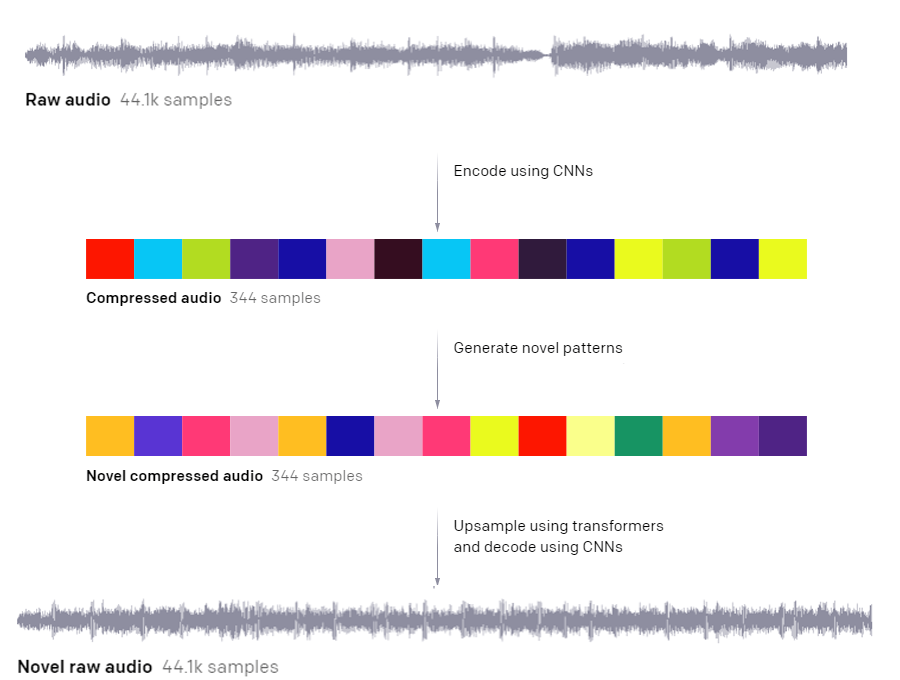
Simplified Graphic from OpenAI Example Pop, in the style of Rick Astley — Jukebox
This example has been generated by giving the AI 10 seconds of the song and generating the rest.
WARNING: Listen for at least 10 seconds only after this the generated part starts
While this song still has a lot of noise in it, it clearly is a step in the right direction.
Future Direction OpenAI, more promising?
Their more recent discoveries come from generating their music by conditioning on a MIDI-file, which you can imagine to be like a music sheet giving rough instructions to the musicians (we are going to explain the details in the end).
I feel this approach will have far more (near-term) success. The goal is basically, given a sheet of music, generate the MP3 recording for me.
AIVA — For Creators
AIVA is much like OpenAI’s Jukebox, an approach to generate music. However, their approaches diverge in the underlying data structure they generate it from. AIVA operates on the so-called MIDI file. Keep imagining the MIDI file to be like a music sheet. The difference here is that OpenAI in the last example took the MIDI file and generated an Audio recording. But AIVA creates, given a MIDI file, a similar yet completely new and different piece of composition.
Their approach is that we can upload a song in the MIDI format. They will use this song to condition their generation process. In other words, this song will influence the generated song.

AIVA Screenshot I tried this with two songs, “Never Gonna Give you up,” and the other being “Super Mario Theme.” After choosing one song to condition on, we are given some options. As of now, we can sadly only condition on one song.
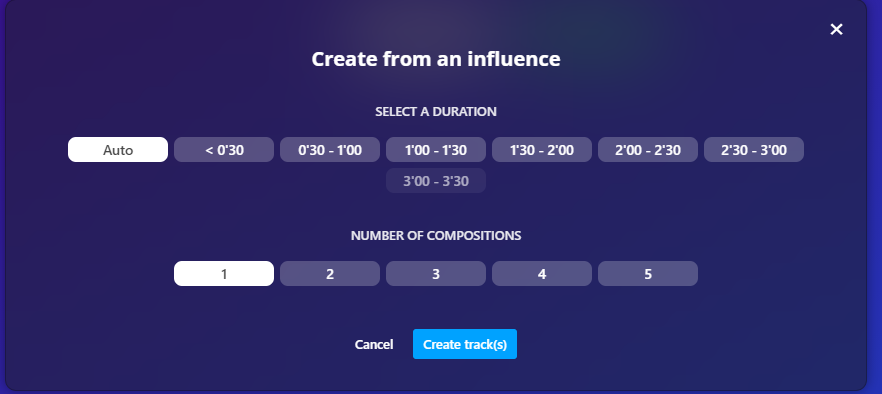
AIVA Screenshot I chose to generate 3 compositions for each influence with a short length of <0:30 seconds. I found that it worked very well on the simple “Super Mario Theme” song and rather bad for the “Never Gonna Give you up” song.
It seems to ignore the more complex song “Never Gonna Give you up,” I assume this is due to the relative complexity. Judge the results of the “Super Mario Theme” yourself.
While I generally feel that this tool can be a great starting point for new compositions and composers, heavy human assistance is still necessary to generate a proper song at this stage.
Amper Music — For Everyone
A completely different approach takes Amper Music. Instead of allowing us to control the generation process, Amper well generates the music. It does so by using so-called Descriptors.
Descriptors are musical algorithms that play a specific style of music. One descriptor might be born to play punky New York rock, and another might excel at chilled out beachside folk — Amper Music
We can at generation time choose two things. One is the length of the song. And the other is a set of (given) adjectives describing the Descriptor verbally. For example, I chose a “Playful Futuristic, Documentary,” and the result is quite lovely and potentially usable. After this, you are also prompted to select a set of instruments to be chosen as a basis. I went with Forks and Knives.
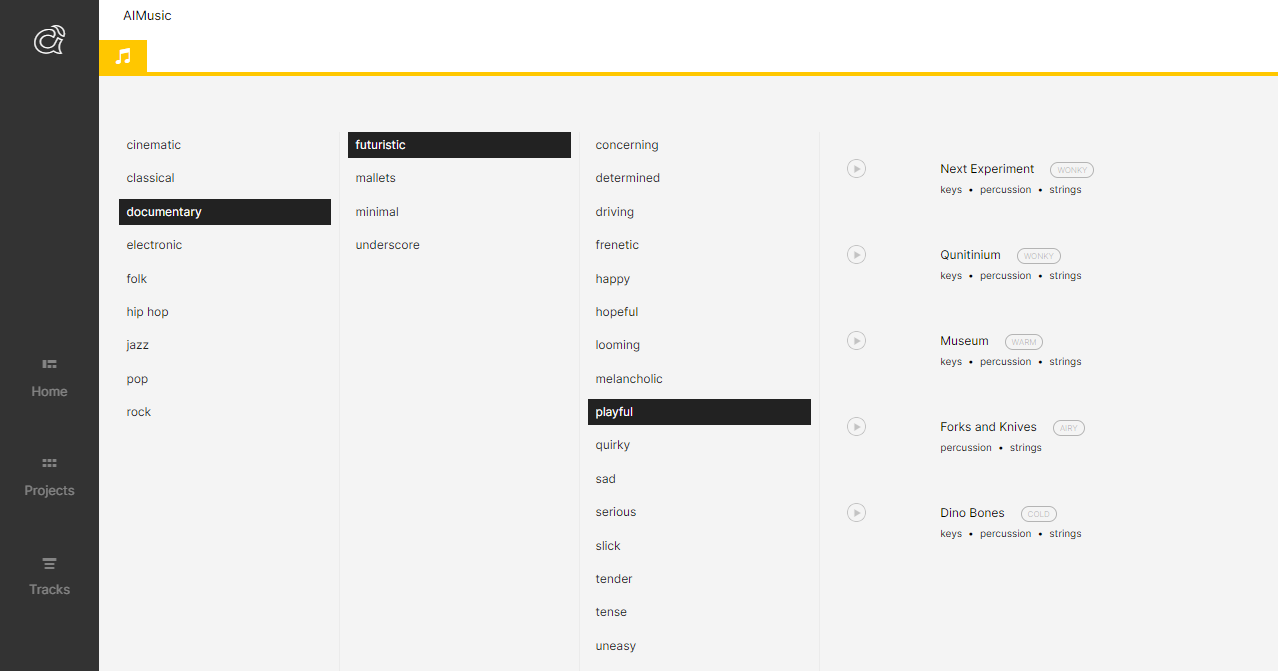
Screenshot Amber music, selection process The result is excellent, and I could see it being a great tune for a documentary about dog toys. When repeating the same selection of parameters, the songs may be quite repetitive but by design.
Piano Roll — How the Approaches are different
While Ampers solution is probably a mix of the other two solutions, it is hard for me to argue how exactly it works. The difference between AIVA and Jukebox is mostly of a data structure (the way the music is stored) nature. To understand the difference between Jukebox and AIVA’s, we first understand the difference between an audio recording and the MIDI standard. A MIDI can, in our case, be understood to be a collection of several Piano Rolls. Where a Piano Roll is basically one Instrument.
The Piano Roll is arguably one of the oldest specialized data structures. The basis of the Piano Roll was created in 1896. Originally designed to make pianos play automatically, they nowadays serve as a canvas for music.
Origin of the Piano Roll On the X-axis, we have the time, and on the y-axis, the pitches in which the piano is currently playing (may include several simultaneously played pitches).
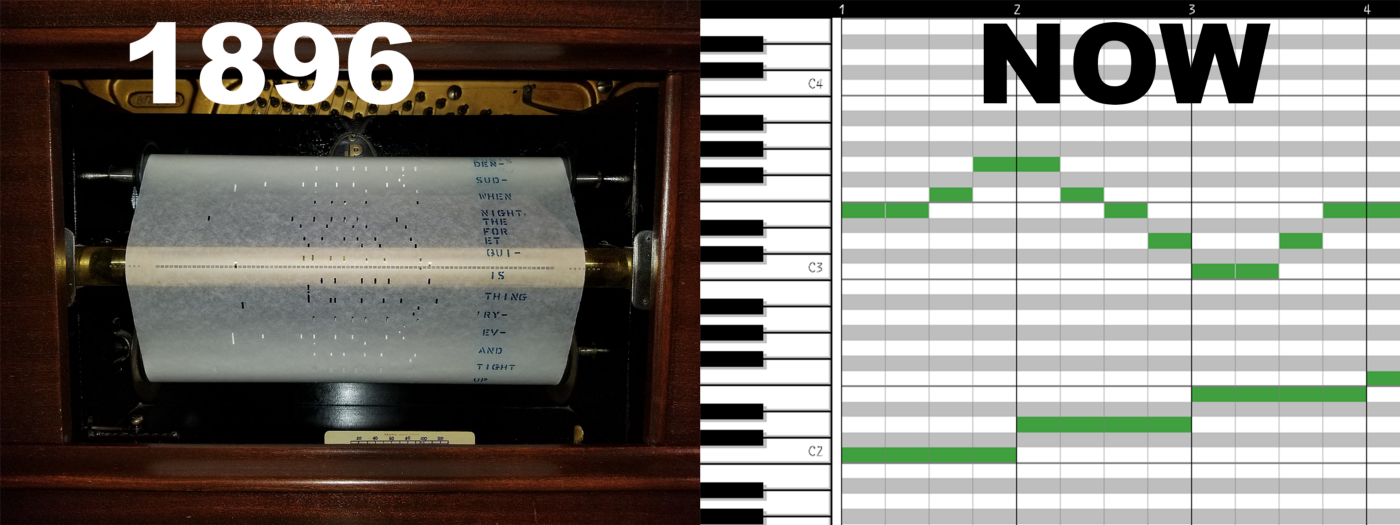
Piano roll history, images from Wikipedia As you might imagine, this approach results in far fewer variables than a complete Audio Wave. For the Piano Roll, we have
Amount of pitches * Amount Of Voices * Amount of Quantization stepsWhich for a 1-minute piece with 4 voices and 64 pitches (which is a common choice for Machine Learning). Would result in roughly
(400)*4*64 = 102'400 possibilitiesAssuming: 1/16 quantization 100 beats per minute all voices are mono, simplified calculation
In contrast, a digitalized audio wave 44’100 Sample Rate will for 60 seconds result in
(44'100*60)*16 = 42'336'000 possibilitesAssuming: 44’100 Sample Rate, and 16bit Word Length and the Sound being Mono
This simplified calculation should illustrate that working on the audio wave directly is far more challenging without going too much into detail. Indeed, additional factors make working on the Audio wave more unforgiving, which was also present as the “noise” part in the Jukebox example. Such noise could not exist when generating in the MIDI format.
The main advantage of working on the wave directly is that the AI model can also create sounds that are not specific to music, such as human speech. Theoretically, they could achieve the level of a human singer’s recording by using the audio wave as a basis.
Conclusion
We have seen that computers can indeed create music that could pass a simplified turning test. The 3 solutions presented all have their place in the AI music ecosystem. AIVA is aimed at musicians that want to create with and get inspired by AI. Amper is a solution for video creators and advertisement specialists that seek to find simple yet usable audio to use in their creations.
OpenAI’s Jukebox is a research project to change how music is created and listened to entirely. While its potential is great, it remains to be seen how far they can push the boundaries between AI and music.
-
ZombieClub Launch – Teahouse Finance
觀察參考 2022/5/12 – ZombieClub Token 地板價 0.85 ETH,研究目前由港星藝人余文樂帶領發行的天花板 NFT 項目。

Zombie Club 發售資訊
- NFT 總數:6,666 顆
- 初始售價:0.666 ETH
- 預售時間:(台灣時間 UTC+8) 2022 年 3 月 15 日 21:00 – 3 月 17 日 21:00
- 預售數量:5,000
- 公售開始時間:(台灣時間 UTC+8) 2022 年 3 月 17 日 22:00
- 公售數量:1,000
- 內部團隊保留數量:666
以下是 Zombie Club 對於 Launch Gas fee 的調研報告說明
白名單的驗證方式
- 在合約指定簽章者地址,然後用對應的私鑰 off-chain 生成簽章,在 mint 時,再於合約中驗證簽章是否正確
- 以白名單地址建立 Merkle tree,mint 時以 Merkle tree proof 檢查地址是否在白名單內
- 將白名單地址全部寫在合約中,直接驗證
第三種方式明顯非常沒效率,而第一種、第二種各有優缺點,在這次 ZombieClub 的發行中,我們是採用第一種方式。
白名單鑄造階段,在合約中會紀錄每個地址已經鑄造過幾個 token,並在生成簽章中使用到允許鑄造的數量,而不再額外儲存其他驗證相關的資訊,達到安全目的的同時,不花費更多的手續費!
公售時的做法
- 依然檢查簽章,在生成簽章的過程中,不論地址為何,都當作白名單,並搭配 reCAPTCHA 防止機器人
- 記錄使用過的簽章,這是要避免科學家使用同一個簽章以腳本大量鑄造的方法,有了這個檢查每次鑄造都需要通過完成 reCAPTCHA 再取得新的簽章,當然如果有個人聘僱了一些人同時幫他操作,這就不在討論範圍了
在公售前與公售時,我們都非常密切關注伺服器以及鏈上的狀態,在公售還沒開始時,伺服器收到了每秒數次的 query,並且在公售後,reCAPTCHA 回報的異常使用者佔了約 50% (白名單時只有 1%),可以說是非常驚人,也說明了 reCAPTCHA 確實有發揮效果;而鏈上也有些人一直嘗試以奇怪的方式鑄造,可能是自行調整參數或是用了一些腳本,我們無從得知,當然這些都失敗了,例如:
https://etherscan.io/tx/0xa06aaa74957f1dd5ac06b034b510a192662f2b09a6b7f1a79c99e6a0197aaeba
https://etherscan.io/tx/0x9ed03adba7abb26733dbe6cf698e752a6fa0320bd59c4bfecbe2450f6f636a94
https://etherscan.io/tx/0xc5e8426fa1b5b1304484a37220ec7c35605304a26c8e36724a417a8189d00707
https://etherscan.io/tx/0x129d3f13910c2cc060cdc334cccba51333bd7df0ddbb3946f0c771d969f840b3白名單與公售為何會有 Gas 的差異
前面已經說明的我們的作法,為了防止科學家大量鑄造,我們在公售時,多儲存了簽章的資訊,在區塊鏈上寫入/儲存資料是需要一定成本的,這也是為什麼公售時,消耗的 “gas” (gas fee = gas limit x gas price) 會略高於白名單鑄造。
為什麼正常操作卻發生 “out of gas” 的問題
在錢包收到發送交易的指令時,錢包會根據合約估計一個 gas limit,而當這個 gas limit 低於真正會花費的 gas 時,就會出現這個錯誤,並且手續費被消耗掉。首先有兩個技術點必須說明:
- 智能合約只負責邏輯的處理,並不能做對 gas limit 的調整
- 前端可以做,但我們並沒有限制 gas limit 的大小
所以可以確定這是錢包估計不正確所導致,一個好的作法是找出所有可能的花費,盡可能高估實際花費的 gas,並設定更高的 gas limit,所以常常會看到某些交易 gas limit 與實際消耗的 gas有不小的差距,像是這個我們隨機找個交易(實際花費大約只有估計的一半):
https://etherscan.io/tx/0xcd268d85a7f322457f5ca9cb75aafaf63b39004b1d57027472cce291ddd4c227
如何估計 gas limit 根據不同錢包可能有不同作法,這我們無法干涉,也有可能是錢包版本太舊,導致其估計的不正確。為什麼有人在公售前就鑄造到?
有些人可能發現到,第一個鑄造到的人時間是在公售前2秒,如下圖:

這個時間是礦工填上去的時間,這個填寫數值可能會與實際時間有誤差,但實際上 #5406 這個 token 是在公售後才鑄造到的,我們已經在合約上做正確的限制以及簽名伺服器只在公售時才開啟,並且在 public sale 時,不斷監控剩餘數量,其沒有提前減少的現象發生,這些各位可以放心,我們團隊也在合約部署後就立刻完成了設定公售時間,如以下 transaction:
https://etherscan.io/tx/0x116a255dd56425afa968f473bf9049ee63d1871489383f8ec84419ce99559f8f真的有防到科學家嗎?
以往一些熱門的 NFT 公售,都會有科學家以腳本搭配超高的 gas price 大量鑄造,造成其中一個錢包大量持有,或是大量 transaction 用了一樣的參數,而一般人都搶不到的問題,我們並沒有限制在公售時一個錢包只能鑄造一隻,但我們希望大家都能公平的鑄造,以下是實施措施的整理:
- 以 reCAPTCHA 搭配簽章防止機器人
- 簽章有效時間是一個小時,所以我們將白名單鑄造結束時間與公售開始時間拉開一個小時的間距,在白名單鑄造結束時,關閉簽章伺服器,並更換簽章私鑰以及地址,確保科學家無法以白名單鑄造時獲得的簽章,用在公售時大量鑄造。
- 為了防止流量瞬間衝高,我們將伺服器設計為不使用資料庫、不連結區塊鏈查詢資料,程式將所有設定存於記憶體中使用,降低伺服器負擔。
我們也分析了公售時地址與鑄造的數量關係,以下為將公售的 NFT 在鑄造完的那個 block 進行快照,統計每個地址鑄造到幾個的關係圖:

我們可以看到其實大部分地址都只鑄造到一個,並且每一個鑄造都用了不同的參數,這是我們樂見且預期的效果,公售的本質就是一種博弈,若要達到 first come first serve 的效果,只有完全的中心化才能做到,我們已經盡力做到最好,確保公平性以及體驗,希望大家可以理解!以上是發行時的細節,祝 Zombie to the moon 🚀🚀🚀
-
Can Artificial Intelligence Make Good Music?
-
Copyrighting all the melodies to avoid accidental infringement | Damien Riehl | TEDxMinneapolis
In the litany of copyright infringement lawsuits, technology lawyer and musician Damien Riehl demonstrates that music is merely math, and has a finite number of possible melodies. If you’ve ever thought a song you like sounded similar to another, the culprit may not be an unethical forger, but rather the limited mathematical musical equations that our favorite artists have to work with. Current copyright law is at risk of severely limiting future music creation and future human creativity. This talk suggests a new way to handle these legal cases. Damien Riehl is a technology lawyer with a B.S. in music. After beginning to code in 1985, and for the web in 1995, he has worked for the chief judges of state and federal courts; litigated for a decade; taught law-school copyright classes; and led teams in software development, digital forensics, proactive cybersecurity, reactive cybersecurity incidents, and world-scale investigations. Damien’s combined experience in the law, technology, and music has inspired his most recent project—copyrighting billions of unique melodies. This talk was given at a TEDx event using the TED conference format but independently organized by a local community.
The project link – http://allthemusic.info/
-
加密資安觀點 – 鏈上交易 vs. 跨鏈交易
加密世界裡,現今多數黑帽駭客都會盯上「跨鏈橋」漏洞,靠其漏洞轉移加密資產。那跨鏈上被盜的「資產」去哪了,因其鏈上的「偽匿名性」特徵和實際 KYC / AML 趨嚴,這時就有一連串的洗錢漂白過程 — 攻擊者每隔幾天就會從錢包裡拿出來一部分錢,轉進 mixer (混幣器) 或一個可以被認為是用來「洗錢」的工具 Tornado Cash。
以太坊聯合創始人 V 神也公開表示支持「多鏈」,而非「跨鏈」,反對以太坊和其他區塊鏈之間使用跨鏈解決方案,認為跨鏈橋會增加資產轉移過程中的安全風險。
跨鏈橋成為區塊鏈安全的弱點,需要從兩個概念談起:鏈上交易和跨鏈交易。
CertiK 工程師介紹,這是兩種完全不同性質的交易。鏈上交易依賴區塊鏈演算法的共識機制——已經被理論和實踐驗證過安全性。如果將區塊鏈看作一個系統,單獨的鏈上交易只是在系統內進行資料更新,達成共識。
跨鏈交易則不然。一個「跨」字,打破了區塊鏈間的壁壘,也意味著「橋」兩端的不同系統需要在一定程度上保持更新一致,而這兩個系統可能存在很大差異。由於每條鏈的設計都只能保證鏈上交易,跨鏈交易需要依賴很多額外的機制,比如對鏈上資訊的監聽、處理和發送,複雜性和難度遠大於鏈上交易。
舉例來說,要將以太坊上的 10 個 ETH 轉移到幣安鏈 (BSC),跨鏈交易的流程大致包括:
- 以太坊端的橋合約收到 10 個 ETH 後,發佈一個轉帳消息;
- 跨鏈網路監聽到這個消息;
- 跨鏈網路調用在幣安鏈端的橋合約,提供與 10 個 ETH 等值的幣給使用者。
整個過程涉及三個相互聯繫但相對獨立的個體:以太坊上的橋合約,跨鏈網路和幣安鏈上的橋合約。它們分處於不同的平台上,相互之間只是通過消息傳遞機制來保證資料在鏈間的傳輸。
跨鏈專案本身是一個複雜的系統,這裡的核心就是消息傳遞機制。一旦這個機制存在漏洞,就可能成為駭客偽造跨鏈消息從而發起攻擊的關鍵。
更好的 Web 3世界 – 跨鏈橋的設置本身是為了去掉各自公鏈的隔閡,各公鏈之間資產可隨意流動和訪問,以免走向單一公鏈獨大,但也形成其他漏洞。因此 Web 3 概念裡,中心化和去中心化的界限並不是涇渭分明的,真實情形是在兩端遊走,但盡可能往去中心化靠攏,要 Decentralize 不要 Centralize。所以 Web 3 的世界仍存在著一定程度「中心化風險」。
駭客入侵事件頻繁發生,一個原因是智能合約在編寫時埋下了安全性漏洞,另一個原因是 DeFi 專案在設計時存在邏輯漏洞,例如沒考慮到加入手續費可能會對交易邏輯產生的影響。
而對於 DeFi 來說,「中心化風險」通常源自某個項目中存在特權帳戶。特權帳戶可以隨意更改智能合約的配置,甚至動用其他普通使用者的資金,存在轉移資金的風險。
警世金句 -「有利益的地方往往潛藏著危機,利益越大,危機越複雜」
-
今日加密世界紀念 – 恐慌 vs. 熊市
Cryptocurrency Prices
2022/5/11 – 今日紀念加密市場大跌,BTC 從昨日 39,427 下跌至 31,628 (↓19.78%),ETH 從昨日 2,933 下跌至 2,391 (↓18.49%)。

NFT Market Price in Taiwan
台灣藝人 – 周杰倫的 PhantaBear 此 NFT 項目也跌至近期低點,地板價來到 0.565 ETH,根據上次本人紀錄日 (5/3) 地板價 0.65 ETH,下跌 13.08%。

1 UST = 1 LUNA = 1 USD ?
美元算法穩定幣 UST,在過去一週之內,兩度與美元匯率脫鉤,本該錨定 1 美元價值的 UST,最低跌落到 0.65 美元,引發信心危機,並衝擊整體加密貨幣市場。
為了向市場證明 UST 有足夠的儲備能夠維持匯率穩定,LUNA 基金會緊急佈署了 28,205 顆比特幣為抵押品,全力買進 UST,擋住了這一波跌勢。到本週二 (5/10),UST 回到 0.9 美元水平,但這一波操作,就拉著比特幣一起下水,幾乎跌破 3 萬美元關卡,讓整個加密貨幣市場一片哀鴻。
在 UST 的算法穩定模型中,UST 和 LUNA 是互為保證的兩種貨幣,目標是讓價值一美元的 UST 永遠可以換到價值一美元的 LUNA,在一系列的浮動變化之中,讓 UST 可以維持錨定 1 美元。問題是,當這個大前提開始破滅,也就是與美元價值脫鉤時,本該互為保證的兩種幣並沒有發揮效果,反而是共同下沉。
美國財政部長葉倫 (Janet Yellen) 一直對於加密貨幣產業採取保守態度,她在昨天出席聽證會時便以 UST 為例,說明穩定幣的問題 — 「現有的法規和監管框架並不足以掌控穩定幣的風險,如果要將穩定幣當成新的支付方式,將引發更多問題。」葉倫表示,她希望國會能加速訂立相關法規,並且願意全力配合議員們的需求。


-
歐洲各國近年發展加密產業現況和教育環境
1. 瑞士第八大城市、義大利語區最大城市的盧加諾 (Lugano) 2022/3/3與 Tether 共同發表合作計劃「Plan B」,將 Bitcoin、美元穩定幣 USDT 和瑞士法郎穩定幣 LVGA 設為實質上的「法定支付貨幣」,企圖將該市打造為歐洲的比特幣之都。盧加諾的目標不僅僅是想挑戰楚格 (Zug) 作為瑞士「加密谷」的地位,而是想成為全歐洲的比特幣之都。其中最引起關注的是「Polygon(以太坊側鏈)」,其作為創始基礎設施合作夥伴,正準備將三個子公司和大量員工遷往該市,Polygon 將成為 Lugano 大部分穩定幣支付結算的通道。

2. 瑞士加密谷-楚格 (Zug),瑞士的避稅天堂州,著名的「Ethereum Foundation」即設立在此,並在2021/2-開放用比特幣和以太幣繳稅。
3. 2022/5/5 – Binance France SAS 已經獲得法國金融管理局 (AMF)、法國金融審慎監理總署 (ACPR) 的同意和批准,將可作為持牌數位資產服務提供商在法國展開營運。這是「幣安交易所」在歐盟獲得的首個數位資產服務提供商註冊許可,並據稱是全球第一家在法國註冊的主要加密貨幣交易所。
4. 2018年加密貨幣交易所「幣安」宣布進駐英屬澤西島,在該地設立幣安澤西子公司,作為進軍歐洲市場擴展計畫的一部分,為使用歐元及英鎊的用戶提供了法定貨幣兌換為加密貨幣的管道。然因交易量不足為由,幣安公告宣布開業不到兩年的幣安澤西子公司於 2020/11/30 完全關閉。
教育環境比較
產、官、學、研是不可分割、相輔相成的關係,美國為全球最大的市場,一堆新創 Crypto Startups 無不想在 Nasdaq IPO,但合規監管力度也最大,我們就來看看其他國家的教育實驗量能如何吧~~求生存就找適合自己的市場–資源、人才、機會🤑~~以台灣的文化政治環境,日本、新加坡也是機會,留待下次好好研究!
英美教育體制
1. 英國大學主流一學年三學期制,頂流高校代表牛津(Oxford)、劍橋(Cambridge)、倫敦帝國學院(Imperial College London)等。
2. 美國為台灣最主流的留學渠道,目前世界第一強權~~經濟、政治、軍事🚀~~強校如雲,如:史丹佛(Stanford)、哈佛(Harvard)、麻省理工(MIT)、柏克萊加州大學(UC Berkeley)等。
歐陸教育體制
3. 瑞士有自然風光,並為早期歐陸避稅天堂代表,金融、鐘錶、瑞士刀產業相當著名,現望能以加密產業帶起經濟。名校如:德語區-蘇黎世聯邦理工(ETH Zürich)~~愛因斯坦母校🤩、法語區-洛桑聯邦理工(EPFL)等。
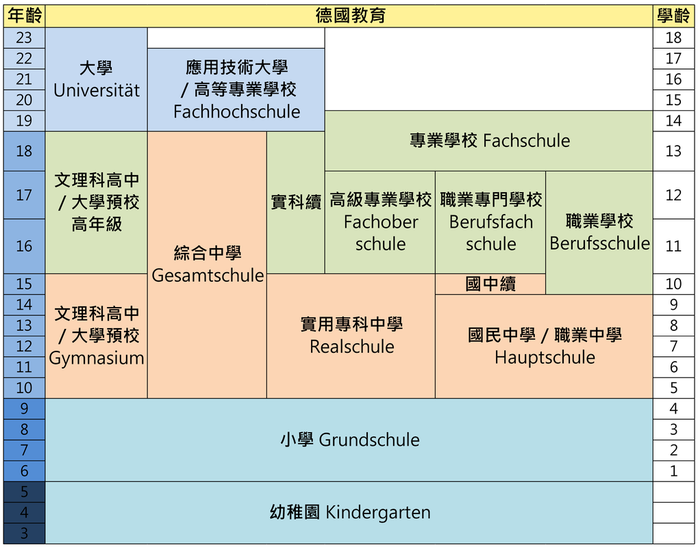
4. 德國較不注重資訊軟體產業,強項在精密製造,像是汽車製造、工具機、精密零件、化學品製造等。專科技職體系相當強,強調專門科目應用實務的專科學院(Fachhochschule–FH)普遍搶手,首都柏林是新創產業的主要聚集地。名校有:慕尼黑大學(LMU)、慕尼黑工業大學(TUM)、柏林洪堡大學(Humboldt-Universität zu Berlin)等。
5. 法國身為浪漫之都、米其林指南發源地,但戰亂不斷-英法百年戰爭、拿破崙戰爭、兩次世界大戰,教育體制也有相似之處,不斷處於教育改革聲浪之中。因其特殊的地域限制,多數學校規模皆較小,主要以高等學院(grandes écoles)培育出來的實務精英較搶手。如:巴黎綜合理工學院 (École Polytechnique,別稱「X」)、巴黎高等師範學院 (École normale supérieure)等。
😄~~我整理以上5國的不同學制和入學時間比較表,副檔傳送門:5國學制比較PDF
德國教育列表
-
Subscribe
Subscribed
Have a WordPress.com account? Log in now.

